
 Language
 English
 Afrikaans
 Albanian
 Amharic
 Arabic
 French
 Spanish
 Russian
 German
 Armenian
 Italian
 Japanese
 Korean
 Portuguese
 Hindi
Hindi Azerbaijani
 Romanian
 Polish
 Thai
Thai Greek
Greek Basque
 简体中文
简体中文 繁体中文
繁体中文 Belarusian
 Bengali
 Bosnian
 Bulgarian
 Catalan
 Cebuano
 Chichewa
 Corsican
 Croatian
 Czech
Czech Danish
 Dutch
Dutch Esperanto
 Estonian
 Filipino
 Finnish
 Frisian
 Galician
 Georgian
 Gujarati
 Haitian Creole
 Hausa
Hausa Hawaiian
 Hebrew
 Hmong
Hmong Hungarian
 Icelandic
 Igbo
Igbo Indonesian
 Irish
Irish Javanese
 Kannada
 Kazakh
 Khmer
Khmer Kurdish (Kurmanji)
 Kyrgyz
 Lao
Lao Latin
Latin Latvian
 Lithuanian
 Luxembourgish
 Macedonian
 Malagasy
 Malay
Malay Malayalam
 Maltese
 Maori
Maori Marathi
 Mongolian
 Myanmar (Burmese)
 Nepali
 Norwegian
 Pashto
 Persian
 Punjabi
 Samoan
 Scottish Gaelic
 Serbian
 Sesotho
 Shona
Shona Sindhi
 Sinhala
 Slovak
 Slovenian
 Somali
 Sudanese
 Swahili
 Swedish
 Tajik
Tajik Tamil
Tamil Telugu
 Turkish
 Ukrainian
 Urdu
Urdu Uzbek
Uzbek Vietnamese
 Welsh
Welsh Xhosa
Xhosa Yiddish
 Yoruba
 Zulu
Zulu
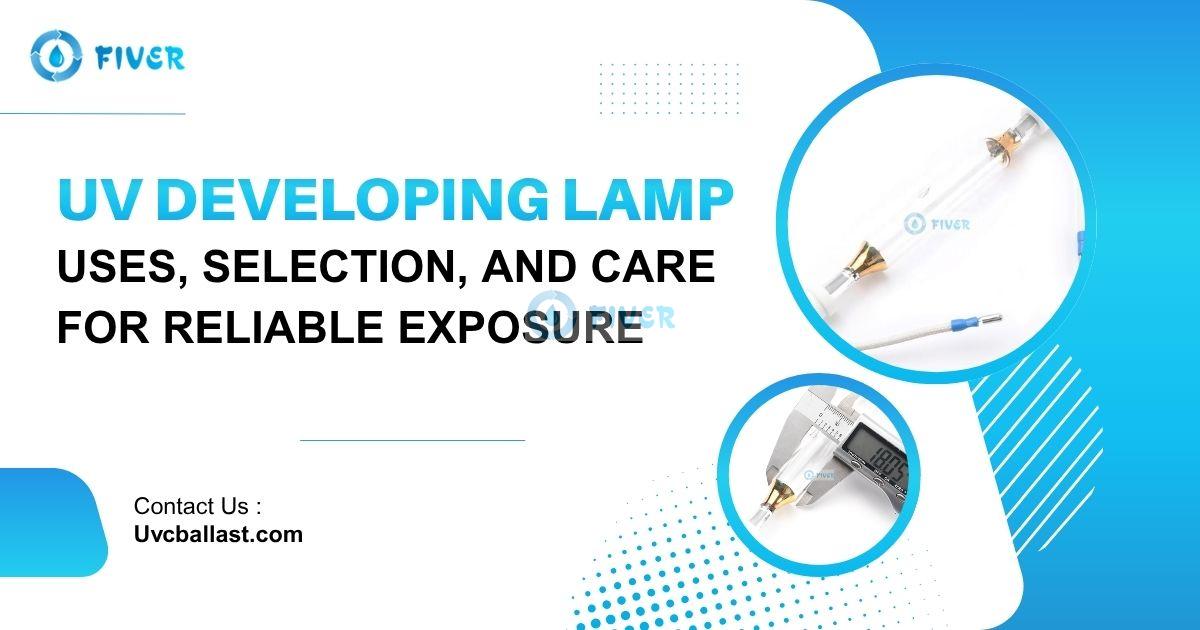
A UV developing lamp exposes photosensitive materials to ultraviolet light so that they can transfer and develop a pattern or image. It is widely used in the production of printed circuit board, screen printing and plate making. The lamp itself is important, but so are the quartz sleeves and the parts that hold them. In this guide we’ll cover what to look for, and how to keep exposure results consistent.
1. What Is a UV Developing Lamp?
A UV developing lamp is an ultraviolet light source for exposing photoresists, emulsions and photopolymer plates through a film or mask. The exposed areas change chemically, and the image is brought out during development.
It is often confused with a UV curing lamp. The two overlap, but the goals differ:
● Developing (exposure): Transfers a fine pattern with controlled dose and uniformity.
● Curing: Fully hardens inks, coatings, or adhesives.
Suppliers use these terms differently, so always confirm the wavelength range and power against your material's datasheet.
2. How Does It Work?
The lamp delivers a set UV dose that triggers a reaction in the light-sensitive layer.
The material is coated or laminated onto a substrate.
A film or mask is placed over it.
The lamp exposes the material for a set time.
Development washes away the unwanted areas, leaving the pattern.
Too little exposure leaves weak or incomplete images. Too much can blur fine detail.
3. What to Check When Choosing a UV Developing Lamp
Start with your material's required wavelength and exposure energy, then check:
● Spectral output: It should match the photoinitiator or resist you use.
● Power and lamp length: They must cover your working area evenly.
● Uniformity and stability: Uneven output causes patchy results.
● Cooling: Air or water cooling protects the lamp and the substrate.
● Power supply or ballast compatibility: Voltage, wattage, and lamp type must match.
4. Why Quartz Sleeves Matter
Quartz sleeves protect the lamp while allowing UV light to pass through. They also help isolate the lamp from cooling air or water and from contamination.
Simple care keeps them effective:
● Handle them with clean gloves, since fingerprints can bake onto hot quartz.
● Inspect for scratches, cloudiness, or mineral deposits.
● Clean them with a suitable solvent and lint-free cloth when the system is off and cool.
● Replace damaged sleeves, as they can reduce UV transmission.
5. UV Ballast Water Treatment Spare Parts: A Related Consideration
UV ballast water treatment spare parts are replacement components for shipboard UV disinfection systems, and they must match the system maker's specifications.
Note that this "ballast" means ship ballast water, not an electrical ballast. These systems also rely on UV lamps, so the same principles apply: matched lamps, intact quartz sleeves, and stable power. Depending on the system, spare parts may include:
● UV lamps
● Quartz sleeves
● Cleaning or wiper components
● Electronic ballasts or power units
● Sensors
Always confirm compatibility with the original equipment specifications before ordering.
6. A Simple Maintenance Checklist
● Track lamp operating hours and follow manufacturer guidance for replacement.
● Measure UV intensity with a radiometer at regular intervals.
● Keep reflectors clean.
● Check connectors, cooling flow, and ventilation.
● Use UV-blocking eyewear and shielding during operation.
Uvcballast is a business of FIVER Environment Group, Limited. It deals in UV lamp power and related components. If you need a specific part, give your lamp or system specs and ask about availability and compatibility
Conclusion
The function of a reliable UV curing lamp is the right lamp, clean quartz sleeves and properly matched power components. Regular checks will help keep the exposure consistent. For UV lamp electronics or UV lamp spare parts, send your specifications to uvcballast.com.
Conclusion
The function of a reliable UV curing lamp is the right lamp, clean quartz sleeves and properly matched power components. Regular checks will help keep the exposure consistent. For UV lamp electronics or UV lamp spare parts, send your specifications to uvcballast.com.
FAQ
What is a UV developing lamp used for?
A UV developing lamp exposes photosensitive materials, such as PCB photoresist, screen emulsions, and photopolymer plates, so patterns can be developed.
Is a UV developing lamp the same as a UV curing lamp?
Not exactly, since developing focuses on image exposure while curing focuses on hardening, though the technologies overlap.
How often should quartz sleeves be replaced?
Replace quartz sleeves when they show scratches, cloudiness, or deposits that cannot be cleaned, rather than on a fixed schedule.
Can I mix spare parts from different brands?
It depends on the system, so verify dimensions, ratings, and manufacturer requirements first.
Do I need a special ballast for a UV lamp?
Yes, the ballast or power supply must match the lamp's wattage, voltage, and type.
Post time:2026-09-21
