
 Language
 English
 Afrikaans
 Albanian
 Amharic
 Arabic
 French
 Spanish
 Russian
 German
 Armenian
 Italian
 Japanese
 Korean
 Portuguese
 Hindi
Hindi Azerbaijani
 Romanian
 Polish
 Thai
Thai Greek
Greek Basque
 简体中文
简体中文 繁体中文
繁体中文 Belarusian
 Bengali
 Bosnian
 Bulgarian
 Catalan
 Cebuano
 Chichewa
 Corsican
 Croatian
 Czech
Czech Danish
 Dutch
Dutch Esperanto
 Estonian
 Filipino
 Finnish
 Frisian
 Galician
 Georgian
 Gujarati
 Haitian Creole
 Hausa
Hausa Hawaiian
 Hebrew
 Hmong
Hmong Hungarian
 Icelandic
 Igbo
Igbo Indonesian
 Irish
Irish Javanese
 Kannada
 Kazakh
 Khmer
Khmer Kurdish (Kurmanji)
 Kyrgyz
 Lao
Lao Latin
Latin Latvian
 Lithuanian
 Luxembourgish
 Macedonian
 Malagasy
 Malay
Malay Malayalam
 Maltese
 Maori
Maori Marathi
 Mongolian
 Myanmar (Burmese)
 Nepali
 Norwegian
 Pashto
 Persian
 Punjabi
 Samoan
 Scottish Gaelic
 Serbian
 Sesotho
 Shona
Shona Sindhi
 Sinhala
 Slovak
 Slovenian
 Somali
 Sudanese
 Swahili
 Swedish
 Tajik
Tajik Tamil
Tamil Telugu
 Turkish
 Ukrainian
 Urdu
Urdu Uzbek
Uzbek Vietnamese
 Welsh
Welsh Xhosa
Xhosa Yiddish
 Yoruba
 Zulu
Zulu
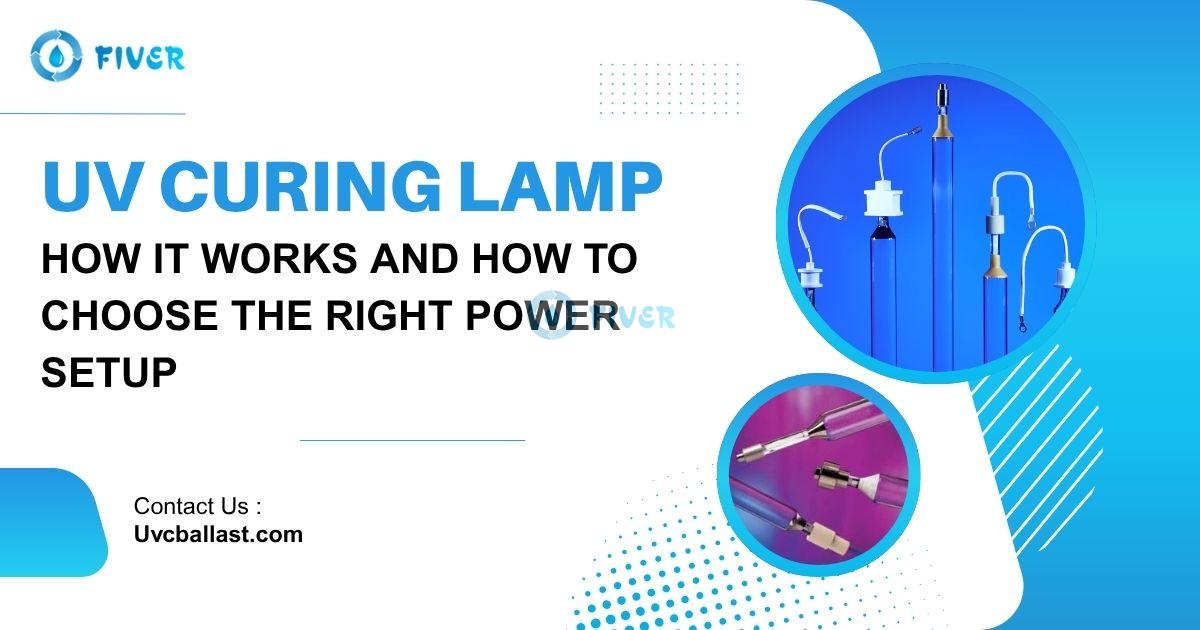
UV curing lamp – Cures inks, coatings, adhesives and resins in seconds. It doesn’t use heat or air drying. But a photochemical reaction. But the lamp is only one part of the system. The electronics behind it will determine how stable , efficient and long-lived the setup will be . This guide explains how a UV curing lamp works and how to match it with the proper power components.
1. What Is a UV Curing Lamp?
UV curing lamps use ultraviolet energy to cure photosensitive materials nearly instantaneously. You’ll find it in printing, wood and furniture coating, electronics assembly and adhesive bonding.
There are two common types:
● Mercury arc lamps: Broad-spectrum output, widely used in traditional curing lines.
● UV LED lamps: Narrow wavelength, instant on/off, and a different power design.
This article focuses mainly on arc-lamp systems, where the power supply and ballast play a major role.
2. How Does a UV Curing Lamp Work?
UV light activates photoinitiators in the coating or ink, which turns the liquid into a solid polymer.
Photoinitiators absorb UV energy at specific wavelengths.
They release reactive species that start linking polymer chains.
The material cross-links and hardens within seconds.
Results depend on wavelength, intensity, exposure time, and lamp-to-surface distance. A weak or unstable lamp often shows up as tacky surfaces or poor adhesion.
3. Why the UV Power Supply Matters
A UV power supply regulates the electrical energy feeding the lamp. Unstable power can cause uneven curing and shorten lamp life. A well-matched supply should:
● Deliver steady output so UV intensity stays consistent
● Support controlled ignition and warm-up
● Allow power adjustment for different substrates and line speeds
● Include protection features suited to the application
4. UV Electronic Ballasts vs. Magnetic Ballasts
UV electronic ballasts are usually lighter, more compact and easier to control than conventional magnetic (transformer-type) ballasts. That’s how they compare:
● Size and weight: Electronic units are usually smaller and lighter.
● Power control: Electronic designs often allow adjustable output, while magnetic types typically offer fixed steps.
● Stability: Electronic ballasts tend to give steadier lamp output.
● Upfront cost: Magnetic ballasts are often cheaper to buy, while electronic models may add value through control and efficiency.
Actual performance varies by model, so always check the manufacturer's datasheet.
5. How to Choose the Right UV Curing Lamp System
Start with the lamp specifications, then match the electronics to them.
Confirm the lamp type, wattage, length, and voltage.
Match the UV power supply or ballast rating to those lamp specs.
Check the input voltage and frequency for your region.
Decide on air or water cooling based on lamp power and environment.
Look for adjustable output and built-in protections.
Ask the supplier for datasheets and wiring guidance.
uvcballast.com, part of FIVER Environment Group Company, Limited, offers UV power supply and electronic ballast options. Sharing your lamp specifications with them is a practical way to check compatibility before you buy.
6. Basic Maintenance and Safety Tips
● Clean reflectors and quartz sleeves regularly.
● Measure UV intensity with a radiometer to catch output decline early.
● Track lamp hours and replace lamps per manufacturer guidance.
● Keep ventilation clear and electrical connections secure.
● Use UV-blocking eyewear and shielding, and never look directly at an operating lamp.
Conclusion
When selecting a reliable UV curing lamp, you need to look beyond the lamp itself. Match with suitable UV power supply or electronic ballast to ensure consistent curing and longer service life. For compatible ballast options, please visit uvcballast.com to discuss your lamp specifications with the team.
FAQ
What does a UV curing lamp do?
A UV curing lamp produces ultraviolet light which dries out UV sensitive inks, coatings and adhesives in seconds.
How long does a UV curing lamp last?
The life span is dependent on lamp type, power, cooling and duty cycle so follow the rated hours of manufacturer.
Can I use any ballast with a UV curing lamp?
No. The ballast needs to match the lamp in wattage, voltage and type to work safely and reliably.
What is the difference between a UV power supply and a UV electronic ballast?
The generic term is UV power supply. An electronic ballast is a type of UV power supply that regulates the current to the lamp.
Is UV curing safe?
It is safe with proper shielding, eye and skin protection and ventilation.
Post time:2026-09-21
